John Keller
The Book of MirrorsJohn Keller is a reporter whose investigation of Richard Flynn’s missing manuscript draws him into the old murder of Joseph Wieder and gradually changes what the manuscript can mean. In Part Two, Keller’s first-person account makes him both investigator and filter: he assembles records and testimony, but repeatedly confronts how little those fragments can establish. The case eventually reaches beyond the manuscript, helping set in motion a renewed inquiry whose revelations overturn Flynn’s theory and leave Keller with a story that cannot honestly be sold as the true-crime narrative he was first asked to find.
Identity and Background
Keller comes to the investigation after a precarious career in journalism. He had entered the occult press through a story about a restorer, then worked for about two years at Ampersand, attending séances and visiting purportedly haunted houses while reporting on the people around that world. When the magazine closed, its owner helped him find a job at the New York Post, where he remained for four years. He later joined a publication launched by European investors, but the decline of small print newspapers left him unemployed. A blog, a news site, and freelance work brought in little money; by his early thirties, he already felt like a relic of an older newspaper business.
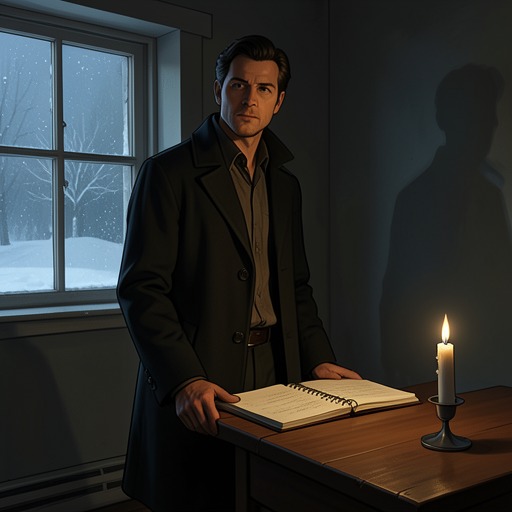
He lives in the three-bedroom apartment in Hell’s Kitchen where he grew up. His parents have moved to Florida, and his older sister, Kathy, has settled in Springfield, Illinois, after college. The apartment is both a practical refuge, since he does not have to worry about rent, and the base from which he resumes the reporting work that eventually absorbs his life. Keller has enough experience linking scattered information to make that work valuable to Peter Katz, a literary agent at Bronson & Matters who approaches him with the Flynn manuscript problem.
The Manuscript and the Investigation
Katz tells Keller that Flynn died the previous month and that his partner, Danna Olsen, has found no trace of the book. The fragment has commercial promise, Katz believes, but it is worthless as a book on its own; the missing material is the essential prize. Since Olsen inherited Flynn’s property and belongings under his will, apart from a few items left to his brother Eddie, Katz wants an agreement with her and needs Keller to locate the rest of the manuscript. Keller accepts the challenge despite seeing no obvious route from a partial text to a missing book.
He begins by rereading the fragment as a reporter rather than treating its claims as settled fact. Different highlighter colors separate Richard Flynn, Joseph Wieder, and Laura Baines; Keller marks Derek Simmons in blue pen because Flynn assigns him an important role. He makes a separate list of the other names in the manuscript, expecting that people’s memories of the past might yield sources, while recognizing that witnesses can beautify what they remember. His first investigative route is an online search for information about the murder and the people involved.
The work soon leads Keller to Laura Westlake, whom he approaches with an explicit account of his assignment: Flynn had written about his time at Princeton and events in the fall and winter of 1987, and the publisher wanted him to test the manuscript’s claims. Westlake questions whether a publisher has already bought it and insists she knew little about any confidential research Joseph Wieder might have conducted. She says she helped with his book but was not privy to other work. Keller leaves unsure how much to believe. Her composed, unusually precise answers and her repeated qualification that she cannot remember every detail strike him as troubling, especially given the manuscript’s account of her past with Flynn and her connection to Wieder. He is careful, however, to identify his sense that she feared what Flynn might reveal as an impression, not proof supplied by her gestures or expression.
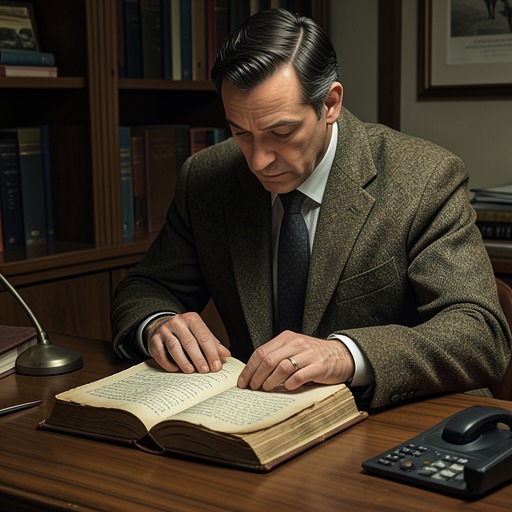
Keller also pursues the paper trail behind Wieder’s proposed book. After a conversation with Susanne Johnson, who discloses that she had loved Wieder without telling him, he contacts Allman & Limpkin. The publisher’s archive initially refuses to speak to the press, but an acquisitions editor eventually follows up. Keller learns that Wieder sent a proposal and the first chapter in July 1987, stating that the manuscript was complete; the publisher sent a contract in August. Wieder was to revise the book with an editor in November, then requested more time to polish it over the holidays. The publisher agreed, but the full manuscript never arrived. The editor sends Keller the nearly fifty-page typewritten proposal, which he prints and fastens together for later reading.
Uncertainty, Relationships, and Cost
The new records do not bring the investigation into focus. Keller’s diagram of what he has found instead makes him feel trapped in a maze: the details refuse to form a coherent picture, and contradictory information accumulates faster than he can interpret it. The story’s apparent center shifts as well. He began looking for Flynn’s book, but Wieder’s stature and history increasingly push Flynn into the background. Keller cannot reconcile the Laura Baines in the manuscript with the Laura Westlake he has met; the two images seem impossible to superimpose.
Keller’s uncertainty is not simply a lack of information. He recognizes that accounts of the past can be shaped by self-interest and faulty recollection, and that an investigator can mistake a persuasive pattern for a proven one. This restraint distinguishes his work from a hunt for a single dramatic answer. Even when he suspects that people are concealing parts of their histories, he does not treat suspicion as confirmation.
The case nevertheless takes a personal toll. Keller agrees with Sam that people often prefer uncomplicated, comforting stories to difficult truths. Later, Roy Freeman learns that Keller has lost his girlfriend because of the story. Keller’s attachment to the investigation thus has consequences beyond his working life, even as he comes to doubt whether establishing the truth will produce justice or matter to the people involved.
From Manuscript Search to Renewed Case
When Keller parts from Sarah Harper, he recognizes the irony that he may have untangled the affair only after it has ceased to matter to him. Wieder has been dead for almost thirty years, and Flynn is dead too. Keller does not see himself as a fanatic serving truth at any cost, and he distinguishes truth from justice rather than assuming one guarantees the other. The unresolved possibility that Laura Baines built her career on lies, perhaps even on a murder, does not make the old case an uncomplicated moral contest.
The investigation later returns to Freeman. Keller visits him with papers about the case and discusses Frank Spoel’s confession to killing Wieder. That contact becomes part of the renewed attention to the murder. Much later, after Keller has spoken with Freeman, the case’s findings reach Katz: Keller explains that the apparent mystery has fallen away. Freeman’s work and the recovered files have changed the meaning of the material that first drew Keller and Katz together.
At dinner with Katz, Keller sees the consequence of the delay in receiving Flynn’s manuscript. Had Olsen sent it earlier, Katz says, he would not have become invested in the story, would not have looked up Freeman, and Freeman might not have reopened the old files. Keller acknowledges the commercial loss—a book to sell—but recognizes that such a book would not have been true. His investigation has, in this sense, produced something more consequential than the manuscript search originally promised: not a clean adaptation of Flynn’s account, but a route toward correcting it.
Ending and Narrative Role
By the time Katz sees him again, Keller is tanned, with a two-week beard, and settled into television work. A pilot he has been roped into co-writing has received a good rating, and he expects another season. The change contrasts with his earlier stretch of low-paid freelance work and suggests that the case has not left him frozen in the role of reporter pursuing an elusive book. He is pleased to hear that Katz is happy in the new job.
Olsen eventually sends Katz Flynn’s manuscript because she understands that publication was Flynn’s last wish. Keller’s conclusion, as conveyed through the outer narrative, is that the manuscript’s premise has been broken by what the investigation uncovered: Flynn’s imagination had embellished real events. Katz prints the 248-page document, but leaves it unread, stored on his desk as a reminder of mortality and judgment. Keller’s story therefore ends not with possession of the missing text or a definitive literary verdict, but with the knowledge that the account’s central interpretations were wrong. Flynn misread Baines, Simmons misremembered what happened after Wieder was attacked, and Wieder misjudged the relationship between Baines and Flynn. Keller’s narrative role is to show how investigation can recover facts without granting anyone a view free of obsession: the people in the case, like those looking through windows, may have been seeing their own reflections.